
Read a Marion County Property Tax Record
No single system holds a Marion County property tax record. The Assessor's card carries the parcel's identity: property class, transfer entries, and assessed values. The Treasurer keeps the money side. That side runs from bills and payments to cash history, tax-sale plans, and redemptions. The Auditor manages deductions, abatements, corrections, refunds, and tax-sale notices. Match the county parcel number, state parcel number, situs, and legal description first. Read the money fields only after the parcel identity checks out.
| Tax-record field | Meaning in the parcel file | Official source |
|---|---|---|
| Land, improvement, and total assessment | Year-specific components used in Indiana's tax system | Marion County Assessor card |
| Property class and tax district | Classification and local taxing context attached to the parcel | Assessor card |
| Deductions and abatements | Adjustments administered for the tax calculation | Marion County Auditor |
| Bill and payment status | Current charge, payment route, and cash-history result | Marion County Treasurer |
| Tax-sale status and costs | Dated sale-layer fields that require status verification | Tax Sale Viewer and Treasurer/Auditor |
The assessed total is not the bill. It is not a sale price either. Indiana uses a market value-in-use standard with a 100 percent assessment-ratio target, and the card reports land, improvements, transfers, and annual assessed totals separately. Rates, deductions, caps, and payment timing all intervene before a tax bill exists.
Search the Marion County Assessor's Exact Fields
The free Marion County Assessor Property Record Card search works without a login. It offers four routes to find a parcel. Pick the most stable identifier and confirm the returned legal description. A familiar street address alone can mislead.
| Search control | Format or use | Required? |
|---|---|---|
| Parcel Number | Seven-digit county number, such as 9058835 | No |
| State Parcel Number | 18-digit Indiana identifier, displayed with or without punctuation | No |
| Owner Name | All or part; entity, initials, and punctuation variants may matter | No |
| Address | Autocomplete; select a suggested candidate | No |
The card can show ownership and mailing address, situs, account and parcel IDs, legal description, township, property class, neighborhood, tax district, transfers, annual values, improvement details, and a building sketch. It is an assessment record, nothing more. Treat it as deed records only if you verify the deed itself elsewhere.
Note: Save the card's report date and assessment year. A later reader then never mistakes an older roll figure for a current one.
Look Up a Marion County Tax Bill
The official Marion County property-tax workflow searches by address or parcel. Address mode accepts a partial street name and an optional owner name. Parcel mode uses the county parcel number. Full and partial ACH/eCheck and card payments are offered. Additional wallet choices come with account creation. Read the result before choosing any payment route.
- Find the Assessor card and copy the seven-digit parcel number, situs, and legal description.
- Run the Treasurer search by parcel or by partial street name, confirming the owner and parcel returned.
- Open the relevant bill or payment result and record its tax year, charge, and status as labeled.
- Review deductions or abatements with the Auditor when the bill does not reflect the expected adjustment.
- If delinquency or sale appears, verify the dated status with the Treasurer and Auditor before acting on it.
- Assessed value
- The roll value assigned to land and improvements for the stated assessment year.
- Levy or tax rate
- The rate component applied within the parcel's taxing context; it is not the assessed value.
- Homestead deduction
- A qualifying owner-occupancy adjustment administered through the Auditor and reflected in taxation.
- Tax lien
- A governmental claim arising from unpaid property tax; verify its status and any release or redemption.
The screenshot below comes from the county's official property-tax workflow.
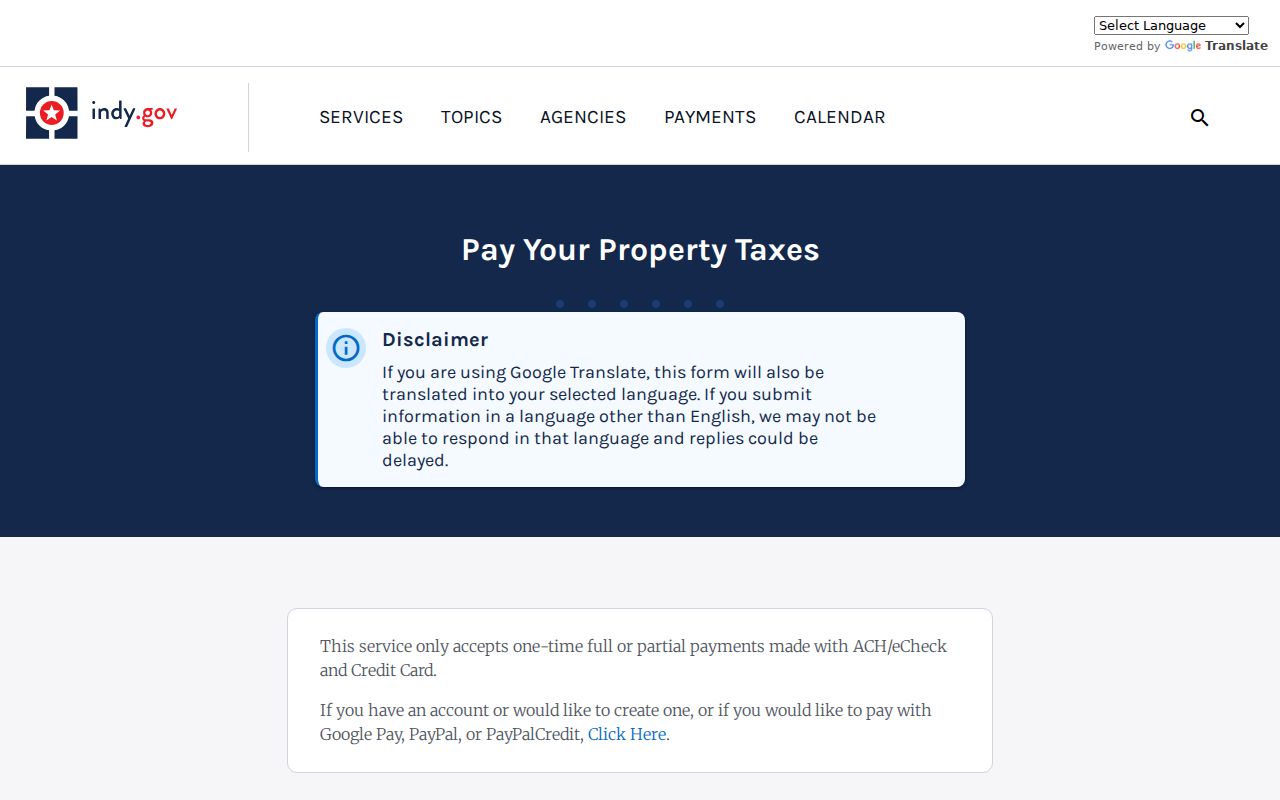
Offering both address and parcel routes, the workflow shows why the parcel number is the cleanest bridge between an assessment card and the right tax account.
Match Cash History to the Right Marion Tax Year
The Property Cash History Report runs in property-address or county-parcel mode. Pick an address candidate, and Owner Name and Parcel ID fill in automatically. Choose the tax year and open the report. The workflow warns that taxes are paid in arrears. So the tax year and payment year may differ. Label both rather than calling every payment current. The official workflow page displays the cash-history entry route and its tax-year control.
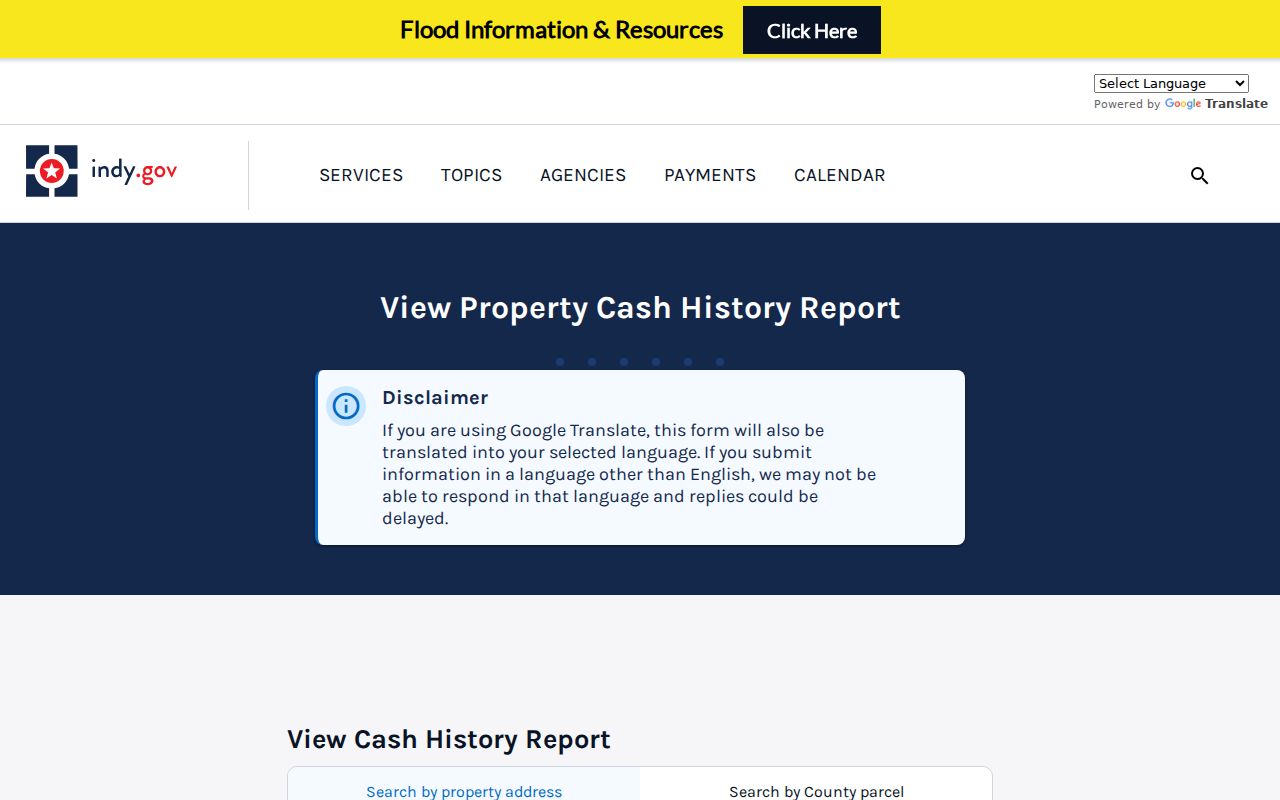
Individual unit records in a multi-unit property may not appear as expected. Go back to the Assessor card, verify the unit-level parcel and legal description, and use the contact path shown in the workflow. Never assume a payment record is missing.
Route Marion County Tax Questions to the Right Office
Marion County property tax records cross three offices by design. The Assessor publishes the property card and the value. The Auditor handles deductions, abatements, bill corrections and refunds, tax-sale notices and redemptions, and homestead-deduction investigations. The Treasurer keeps the tax records and prints bills. The office also receives payments and manages tax-sale plans and payments.
| If the issue is... | Begin with... | Carry this evidence |
|---|---|---|
| Parcel facts or assessed amount | Assessor | Card, parcel IDs, value year, and field questioned |
| Deduction, abatement, correction, or refund | Auditor | Bill, deduction record, notices, and parcel identity |
| Bill, payment, cash history, or payment plan | Treasurer | Tax year, bill/result, parcel number, and receipt |
| Recorded tax instrument or ownership proof | Recorder | Party name, legal description, and document reference |
When an existing nonexempt record is missing online, Indiana's Access to Public Records Act, IC 5-14-3, permits a reasonably particular inspection or copy request during regular business hours. Name the office, parcel, record type, year, and document sought. APRA does not require an office to build a new analysis.
Read Marion County Tax-Sale Status Cautiously
The Marion County Tax Sale Viewer maps sale-related parcels with area-of-interest tools, including a visible Buffer control. Its data disclaimer says locations are approximate and calls for due diligence. The companion tax-sale parcel search accepts an address or parcel plus a tax-year selection.
The public parcel layer beneath it carries parcel number, sale ID, tax year, status and status date, tax-sale costs, fees, delinquent-tax fields, minimum bid, address, ZIP, township, legal description, and geometry. A coded or dated layer result is only a lead. It does not prove a parcel is still eligible, was sold, was redeemed, or is occupied.
Verify before relying on a sale label. Confirm the current meaning and date with the Treasurer or Auditor, then check Recorder and court records for any instrument, redemption, or proceeding that changes the trail.
Note: Describe only the status actually displayed, and do not infer a person's finances or the property's condition.
Track Indiana's 2026 Reassessment in Marion County
The Department of Local Government Finance cyclical reassessment begins July 1, 2026. Indiana plans to reassess 25 percent of parcels in each of four years. The 2026 work affects Pay 2027. That statewide timetable is exactly why a Marion County property tax record matters. It must keep its value year and pay year explicit.
The schedule alone proves nothing about a particular Marion parcel. Check the parcel's Form 11, card, and bill. Do not project a countywide result from a statewide announcement. A value change can also come from parcel facts, improvements, classification, or other record-specific circumstances.
Why Three Marion County Numbers Rarely Match
A parcel card, a deed, and a tax bill rarely agree. That is by design. The assessor's card shows an assessed total. A deed may state recorded consideration. The Treasurer builds the tax bill from the applicable assessment. The tax rules in force shape it too. Each number answers a different question and often reflects a different date.
Common myth: these figures are not interchangeable. Keep every label, date, and source straight before comparing anything.
Consider parcel 9058835, a residential card displaying land and improvement detail, annual assessed totals, and a 2024 transfer. Those fields form a solid assessment record. The transfer row, though, does not prove the amount was an arm's-length price. For a deeper look at valuation types, see the Marion County property value guide.
Appeal a Marion County Property Assessment
Indiana's property-tax appeal guidance points to Form 130, the Taxpayer's Notice to Initiate an Appeal of Assessment, filed with the local assessor. Frame the appeal around the exact parcel, the assessment year, the Form 11 or TS-1 notice, the claimed error, and supporting evidence. A tax bill that simply feels too high is not an argument.
- Review the Assessor card, Form 11, and tax-bill TS-1; identify the assessment and year being challenged.
- Gather evidence tied to the issue, such as grade, condition, property facts, or a recent appraisal.
- File Form 130 with the local assessor by the applicable June 15 deadline and retain proof of submission.
- Participate in the informal conference and review the assessor's recommendation.
- If unresolved, proceed to the Property Tax Assessment Board of Appeals (PTABOA), then the Indiana Board under the state sequence.
Calendar control. If a Form 11 is received, file by June 15; if no Form 11 is received, the deadline is June 15 of the following year. Confirm the governing notice and current instructions before filing.
The Marion online subjective-appeal workflow walks through grade, condition, a recent appraisal, ownership or a recorded contract, the property address, any purchase within three years, property type, reason, owner and mailing details, applicant relationship, email, and telephone. It fills in owner and parcel data automatically once an address is chosen.
The official Marion County subjective-appeal workflow page shows these steps in order.
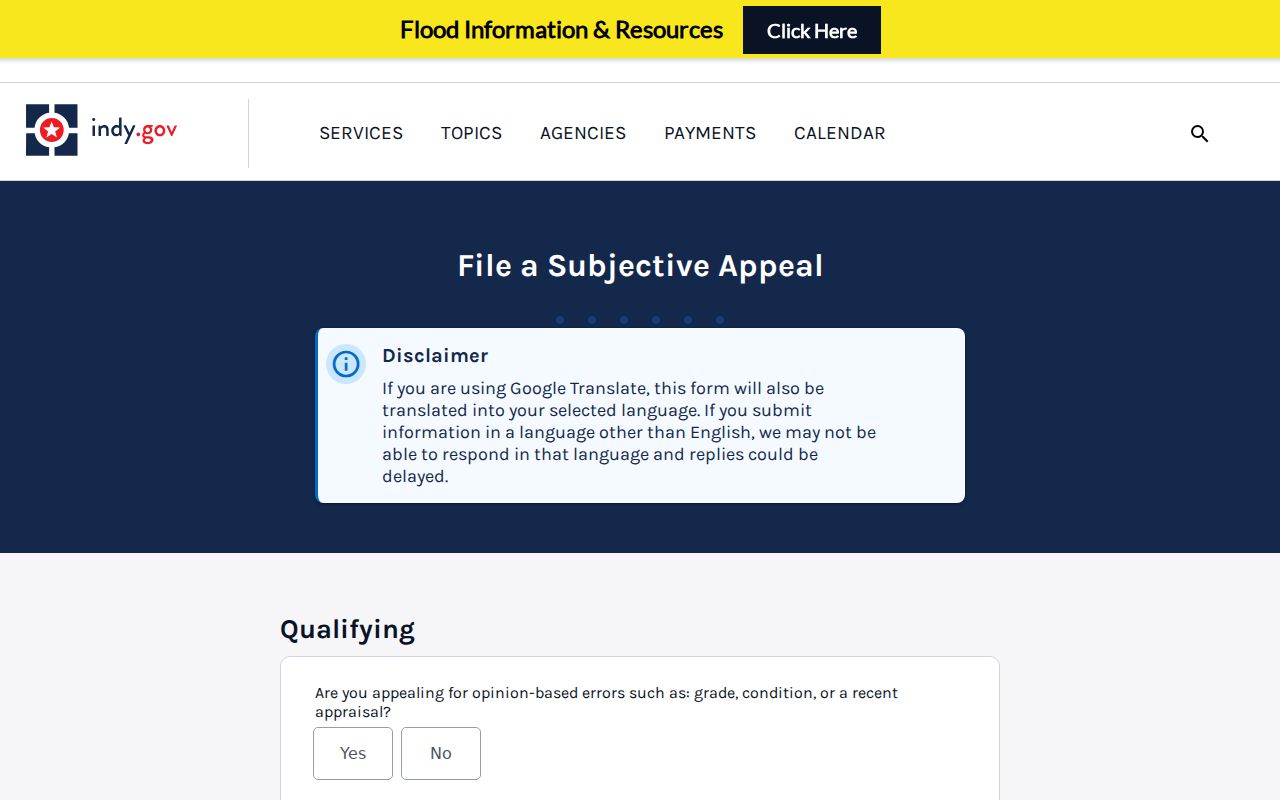
The form's detailed questions make the point plainly. An appeal needs evidence aimed at one specific assessment issue. It is not a general property-owner search.
Get Marion County Tax Records Beyond the Portal
Portals are fast, but they are not the only way in. A parcel-card or valuation question belongs to the Assessor. Call and name the parcel, the report year, and the exact field. Bill, payment, payment-plan, and cash-history questions belong to the Treasurer. Deductions, abatements, refunds, corrections, and tax-sale adjustments go to the Auditor. A portal may not reach every existing public record. A well-drafted APRA request offers a written inspection or copy route for those.
Litigation changes the picture. Use Indiana MyCase for public, nonconfidential court metadata. Request the full official file from the Marion County Clerk or court when the docket falls short. For a recorded lien, release, sheriff's deed, or other land instrument, check the Marion County Recorder index. Keep the three separate. A court allegation, a tax-sale map marker, and a recorded instrument are distinct records. Collapsing them into one conclusion invites error.
Portals sometimes fail. A portal may reject an address, drop a multi-unit parcel, or lack a certified document. Phone, mail, and counter service still matter in those moments. Gather your details before contacting any office: the seven-digit parcel, the 18-digit state parcel, the legal description, the relevant tax year, and any notices or screenshots. That precision helps staff pull the right Marion County property tax record. It also preserves a research trail you can reproduce.