
Build a Marion County Former-Owner Timeline
Open with the current Assessor card and its newest deed. Then give every transfer its own line on a timeline. The sequence keeps prior owners in order and flags any gap that may call for an estate file, a plat, an earlier parcel number, or a much older deed volume.
| Transfer Date | Grantor to Grantee | Deed Type | Reference |
|---|---|---|---|
| Newest first | Prior owner to current grantee | As indexed | Instrument or book/page |
| Next earlier | Earlier grantor to that prior owner | As indexed | Matched legal description |
| Offline era | Names read from reverse index and deed book | As written | Volume and page |
A warranty deed and a quitclaim deed are simply instrument forms. The labels say nothing about whether a Marion County chain is complete, so record the wording exactly as written rather than inferring its legal effect.
Start Marion County's Chain with the Current Grantee
Pull the current parcel number, state parcel number, legal description, and situs from the Assessor card first. Also grab any transfer clues from the card. Then open the Marion County Recorder index. Search there for the newest deed naming the current owner as grantee. That instrument anchors the whole reverse chain.
The index supports grantor, grantee, recording date, document type, book and page, and legal-description searches. Its page reports indexed records through May 17, 2026. It cautions that indexing may lag behind that date. Contact the Recorder directly if the results stay muddy. The Marion County Recorder index page itself displays the public entry point. That entry point serves the reverse-name method.
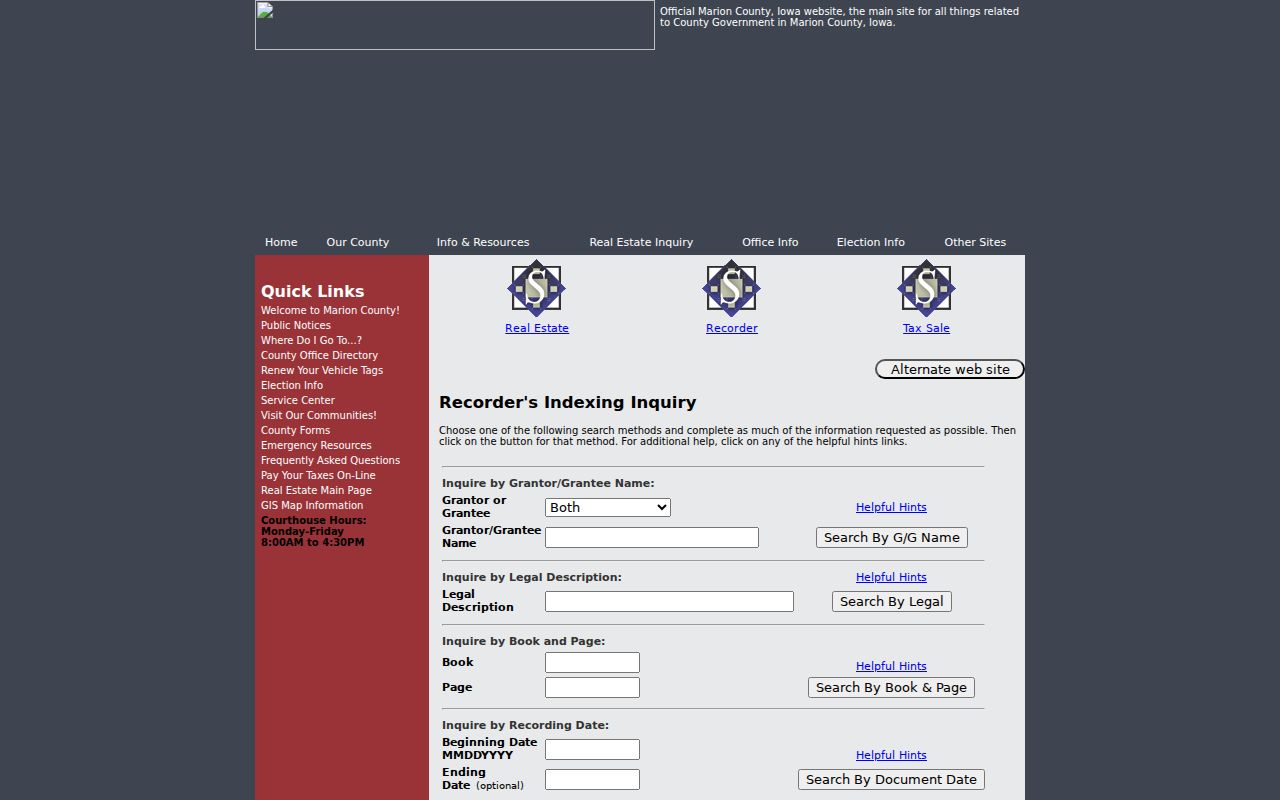
Treat the index's name and legal-description fields as the first bridge backward. Log the exact instrument or book-and-page reference before you take the next step.
Walk the Marion County Deed Chain in Reverse
Each deed hands you the name for the next search. Move from the newest reliable conveyance toward the past, and recheck the land description at every step.
- Find the current owner's acquisition deed and record its grantee, grantor, date, and reference.
- Search the grantor as a grantee during the earlier period when that party acquired the land.
- Compare legal-description text, plat, lot, block, acreage, and prior references.
- Repeat until the online trail ends, then move the same names and description into the book index.
- Grantor / grantee
- The conveying party and receiving party named in the deed.
- Chain of title
- The ordered sequence of recorded interests affecting the parcel.
- Reverse index
- An index route organized to search the receiving party.
Continue Marion County Ownership into Deed Books
Marion County's Recorder keeps a permanent real-estate archive. It begins in 1821. The Indiana State Library's Marion County microfilm guide maps the early route. Deed Book L-1 holds 1822 through 1827 material. The L-series runs through L-28 for 1866 to 1869. Carry the last known grantor, grantee, legal description, and book and page into the offline search. Digitized images do not cover every volume. When an image is absent, the State Library county guide, the Recorder, library collections, and Records Management provide fallback paths. Under Indiana APRA, IC 5-14-3, you may request an existing record with reasonable particularity.
Bridge Marion County Parcel Splits and Combinations
One Beech Grove sample card carries a memorandum. It says parcel 1087529 was combined into 1087088 for 15P16. Search both identifiers. Former owners and older instruments may remain indexed under the prior parcel number. Its legal description matters too. Lot-and-block wording such as OAKMONT L79 & L80 can outlive identifier changes. A recorded plat, replat, or combination note is more dependable. Guessing from a modern street address can mislead.
Note: A parcel-number change is not an ownership change, so keep the land's identity and the deed parties as separate questions.
Translate Old Indianapolis Addresses Before Rejecting a Match
Indianapolis renumbered its addresses in 1887, 1899, and 1916. So an old owner can seem to vanish. A directory, map, or deed may simply carry an earlier house number. The Indianapolis Public Library house-history guide ties together directories and Baist and Sanborn maps. It also ties together newspapers and local-history sources. Compare surname, street, cross streets, plat, block, lot, township, map orientation, and deed-book reference before ruling out a match. Modern geocoding alone is too weak to pin an old address to a current parcel.
Use Marion County Transfer Rows as a Check
Assessor transfer tables can list grantor, sale amount, transfer date, and instrument type. Sample card 1049686 covers an LLC with three-family history. It works well for testing a chain against multiple prior sales. Still, a transfer row is a secondary clue. It is not the deed. Estate and probate transfers can also interrupt a tidy purchase sequence. Search Marion court records through MyCase when a public estate case matters, then pull the complete file from the Clerk or court. Sealed and confidential records stay off limits.
Measure the Depth of Marion County Ownership Records
Online reach, indexed reach, image reach, and office custody are four different things. The Recorder's archive starts in 1821. State Library microfilm covers the earliest deed books. Anyone tracing Marion County ownership should name the source consulted and the exact point where the chain stopped.
Offline cutoff. When the web index or image trail ends, continue through Recorder-held volumes and State Library microfilm rather than assuming no earlier owner exists.
Former-owner research supports house history, estate work, and lawful property diligence. It does not show who lives at an address today. No historical name should ever be used to track or harass a living person.
Test Marion County Former Owners Against Plats
A deed chain can hold the same land while street numbers and parcel numbers shift around it. Continuity is testable. Recorded subdivision names, lots, blocks, exceptions, and acreage descriptions give you that test. Marion County examples include OAKMONT L79 & L80, Beech Grove Add Sec A lots in Block 126, and a Raymond Street subdivision lot with a measured exception.
Sometimes one transfer cites a street address. The next offers only a legal description. Find the subdivision in MapIndy. Then seek the recorded plat from the Recorder. A plat can expose replats, vacated rights-of-way, easements, and lot geometry that explain why the wording changed. It will not supply the owners itself.
Keep the plat name and its recording reference beside the deed row where it first appears. That builds a durable bridge. It holds even when a current search no longer recognizes the earlier address.
Record Marion County Chain Gaps Honestly
A Marion County deed list can look complete and still miss something. An estate transfer slips through. A name variant hides a deed record. An unindexed image or a parcel split goes unnoticed. Instruments recorded under legal-description terms instead of surnames are easy to overlook, too. Bracket every gap with the last confirmed deed and the next confirmed deed. Then search both parties as grantor and as grantee across that interval.
When the gap holds, go deeper. Deed-book indexes, assessor transfer rows, probate dockets, historic directories, and plats all carry clues. Each can move a Marion County property search forward. Ask an office for a specific volume, party, period, or instrument. Avoid requesting a full house history. Older material sometimes moves out of active systems. Records Management and library holdings serve as fallbacks.
Label your results honestly. Sort confirmed transfers, supporting clues, and unresolved intervals into separate columns. A former owner is a historical record subject. They are not necessarily a current resident, heir, or anyone still tied to the land.
Some Marion County chains hit a turning point. A trust can interrupt the run of ordinary deeds. So can an estate, a sheriff's deed, a parcel combination, or a changed legal description. Preserve that transition rather than skipping it. Search both sides of the transfer. Check the prior parcel number before going farther back.
Probate or court material may explain what happened. The recorded deed or court order still has to match the land itself. If the jump cannot be closed, mark it as a gap. Never insert a likely owner into Marion County property records on a guess.
Log every citation as you go. Book, page, document number, date, and legal-description match all belong in the chain log. Those details let the next property search resume from evidence instead of a guessed surname.