
Documents Inside Marion County Deed Records
The Marion County Recorder is the permanent custodian for real-estate instruments. A deed changes or confirms who holds the stated interest in land. Other filings do different work. Some burden the land, some limit it, and some release earlier claims. Read the instrument itself before trusting any index label. Check its legal description too. That is the whole record.
| Deed Type | What It Does | Common Use |
|---|---|---|
| Warranty deed | Conveys the stated interest with deed warranties | Ordinary sale |
| Quitclaim deed | Conveys whatever interest the grantor holds without title warranties | Family, trust, or corrective transfer |
| Trustee or executor deed | Conveys under stated fiduciary authority | Trust or estate administration |
| Sheriff or tax deed | Records a transfer under a court or tax process | Foreclosure or tax sale trail |
Mortgages and liens are encumbrances, never deeds of ownership. Hunt for releases, easements, restrictions, surveys, and plats on their own. The assessor's transfer table does not inventory them at all.
Search the Marion Recorder Index
The free Recorder index lets you choose Grantor or Grantee, then search by party name, legal description, book and page, or recording dates entered as MMDDYYYY. Start with the exact party spelling. Then try initials, dropped punctuation, entity forms, estate capacity, and trustee wording.
| Index field | Purpose |
|---|---|
| Grantor/Grantee | Separates transfers out from transfers in |
| Party name | Finds a person, entity, estate, or trustee |
| Legal description | Matches the result to the land |
| Book/Page | Targets a known historic citation |
| Date range | Narrows the recording period |
The page reports documents through May 17, 2026, while cautioning that indexing may lag behind that date. So one failed exact-name query proves nothing about whether a deed exists.
Walk the Marion County Grantor-Grantee Chain
A grantor gives the interest a deed describes. A grantee receives it. The chain of title is the full linked sequence of transfers touching the same land. Every link must match the parcel's legal description, not just a surname that looks familiar.
- Find the newest deed naming the current published owner as grantee.
- Record the grantor, date, deed type, legal description, and citation.
- Search that grantor as an earlier grantee to find the prior acquisition.
- Repeat, then carry the last citation to deed books or microfilm when needed.
- Grantor
- The party transferring the stated interest.
- Grantee
- The party receiving that interest.
- Chain of title
- The ordered sequence of recorded transfers for the land.
- Book/Page vs Instrument Number
- Older volume citation versus a newer document identifier.
Marion Deed Books Reach into the 1820s
The Indiana State Library county guide lists Deed Book A covering 1822 through 1827. It also lists Index Deed Book B covering 1827 through 1830. Its microfilm runs continue into the late 1860s. The Recorder describes an archive reaching back to 1821. Write down the newest old book and page, the legal description, the approximate date, and the party names before going offline.
A 2017 project digitized more than 2.5 million documents from 1821 through 1964. The source cautioned that full indexing would take years to finish.
July 2026 Shows Marion's Recording Scale
A dated Recorder update counted 11,084 documents for July 2026. That total split into 9,633 e-recordings and 1,451 paper filings. It also included 1,115 new Property Fraud Alert signups. The free alert is warning-only. It will not block a filing, rule on fraud, cure a title defect, or spare you from reading the deed itself. That volume also explains a common lag. A fresh instrument can reach the Recorder before another office's published card shows it.
Use the Assessor Transfer Table as a Lead
An assessor card can surface a grantor. It can also show a sale amount, a transfer date, and a transfer type. Parcel 1049686 is one example. It carries LLC transfer rows and Raymond Street subdivision text. Treat that as a bridge into deed records, not a full chain or encumbrance index. Search each party in the Recorder index and compare the exact legal description. Mortgages, covenants, liens, easements, and releases may never appear in the assessment transfer list.
Note: A transfer amount should not be assumed to equal recorded consideration, current market value, or a complete statement of the transaction.
Request a Marion County Deed Copy
Identify the document in the index first. Then follow the Recorder copy guidance to order it. Reported charges ran $1 per page for paper and electronic copies, with certified copies available in person or by mail, so confirm current fees before paying.
Recorded, not guaranteed. Recording gives public notice, but it does not prove clear title or eliminate competing and unrecorded interests. The Recorder cannot give a title opinion.
The office is at 200 E Washington Street, Suite 741, Indianapolis, IN 46204, with phone 317-327-4020 and recorder@indy.gov. APRA, IC 5-14-3, supports a request for reasonably identified public records but does not require staff to create a title report.
The Recorder search form shown below is the source interface for the party and date searches.
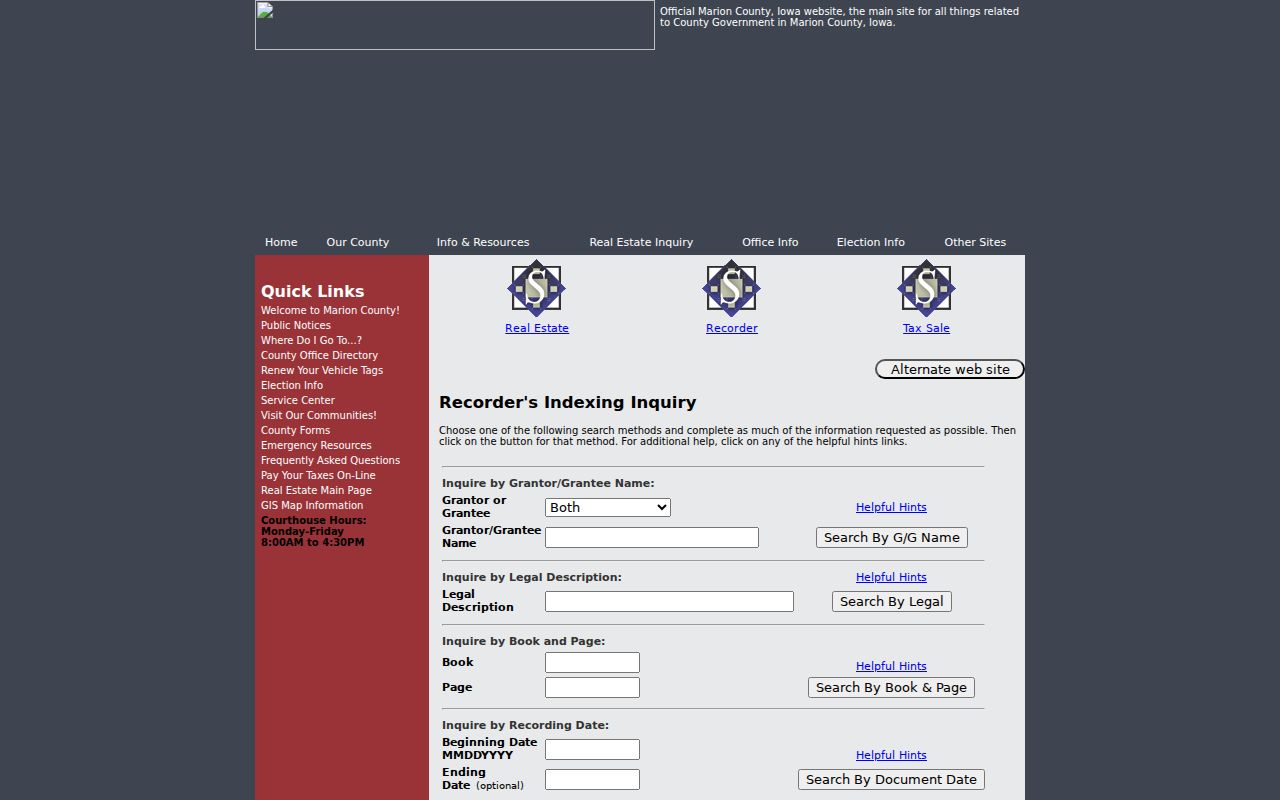
On the form itself, party role, legal description, dates, and book/page each work as separate search tools.
Match Marion County Deeds to Legal Descriptions
A street address is an easy way in. The legal description is the stronger bridge. It is what ties one Marion County deed to the next. Assessor samples show the range: HILLSIDE VILLAS TRACT 6 BUILDING 6 UNIT C; BERTHA MUSSMANN'S RAYMOND STREET SUBDIVISION L3 with a measured corner exception; OAKMONT L79 & L80. Beech Grove Add Section A lots in Block 126 round out the list. Copy the distinctive wording into the Recorder index. Use the subdivision name, lot, block, tract, unit, acreage, and any exception language. Punctuation can vary between entries. Begin with a short unique phrase, then narrow the candidate results by party and date. A metes-and-bounds description often demands the full deed image. The index cannot carry every course, exception, or easement. Plats complicate things further. A replat, a vacated right-of-way, or a parcel combination may have changed the modern tax record. Keep both the current and prior identifiers in play. Card 1087088 says parcel 1087529 was combined into 1087088 for 15P16. That memorandum justifies searching the old number. It does not prove every instrument under it touches all of today's parcel. Platted and metes-and-bounds parcels reward different reading habits too. A platted lot usually points to a recorded subdivision map. An acreage description leans on bearings, distances, exceptions, and prior deeds. Find the instrument in the index, then inspect the attached exhibit or referenced plat. Never shorten an exception clause. It decides whether two Marion County deeds describe the same land.
Separate Marion County Deeds from Encumbrances
A Marion County deed is only part of the story. The Recorder's land archive also holds mortgages and assignments. It holds releases, judgment liens, tax liens, easements, restrictive covenants, and plats. Each of these can attach to the same parcel. A transfer table on an Assessor card inventories none of them. So after you trace the deed chain, search those document types and party roles separately.
Match each instrument to what it actually does. A release should line up with the obligation it purports to release. An easement needs to be read with its legal description and any referenced exhibit. A mortgage names borrowers and lenders. Yet the lender never becomes the parcel owner by that fact alone. Recording itself gives public notice of a filed document. It settles neither priority nor every unrecorded claim.
Court context calls for a different source. Indiana MyCase offers public docket access to nonconfidential Odyssey cases. Those cases cover foreclosure, quiet-title, probate, or judgment matters. When a docket entry matters, get the complete public file from the Marion Clerk or court. Court records and Recorder instruments answer different questions. Merging them into one unsupported title conclusion invites error.
Chronology matters as much as document type. Record the execution date, recording date, parties, and cross-references separately, because those dates often differ. When a release cites an earlier mortgage or lien, match the cited instrument number or book and page. Do not trust similar names. A same-name result elsewhere in Marion County may concern entirely unrelated land.
Continue Marion County Deed Research Offline
When the online index, image, or spelling does not resolve a deed, preserve the last confirmed citation and use every documented access channel. The Recorder accepts in-person and mail copy requests and provides electronic copies under its procedures. The Indiana State Library's Marion County research guide and microfilm finding aid support early-volume work, while Indianapolis Public Library house-history resources connect deeds with directories and historic maps.
Indianapolis street numbers changed in 1887, 1899, and 1916. An old address may therefore fail in a modern parcel search even when the deed is correct. Compare surnames, street and cross streets, subdivision, lot and block, township, map orientation, and deed-book citation. Historic directories document occupancy rather than ownership, so use them to bridge the address and return to the deed.
An APRA request should describe an existing record with reasonable particularity: party names, approximate recording period, document type, legal description, and any known book/page or instrument number. If the office cannot locate it under one spelling, ask what index, volume, or transferred collection covers the period. Document the gap instead of inventing a missing link.
Save a research log that distinguishes index metadata, viewed images, certified copies, assessor clues, court references, and library aids. Note the date each source was checked and quote legal-description text exactly. That discipline is vital when an online index warns of lag or a digitization project covers images more broadly than searchable names. It also lets a title professional reproduce the path without mistaking an unverified clue for a recorded link.